Affichage des articles dont le libellé est Morocco. Afficher tous les articles

vendredi 25 septembre 2015

Pavilions of Expo 2015 Milano : MORROCO


Morocco, A Journey of Flavors

Continuing of the Expo Milano 2015 tour... towards the pavilion of Morocco.
This country participates in World Expos since the first, with consistent quality, and each time, show to million visitors a beautiful and original pavilion, with exciting content.
At the Milan Expo, Morocco is no exception to the rule, and offers us a visit, or rather "a journey of flavors", a whole program, to help "feed the world" ... so nice!


The Moroccan Pavilion is located in the eastern part of the Expo, close to the Roserio entrance, in a large space, a beautiful development of the architecture for the less original, but also very typical. The color is given, it's a construction that reminds us kasbah of Ouarzazate, built of adobe, on a wooden structure, like the Berber architecture of southern Morocco. It's both traditional, evocative of the country of origin but also very sustainable, the environment is also one of the major concerns of Morocco!

The Kingdom Morocco is a country that knows very well combine tradition and modernity, we already felt before entering, and of course, also inside the pavilion.


One never tires of admiring the pavilion that seems to invite us to come for a change of scenery for a real immersion in this country so welcoming.

We must thank already the pavilion's team for his kindness and explanations lavished during this visit-discovery. At the entrance of the pavilion, before passing the door, we are greeted by a large portrait of His Majesty King Mohammed VI of Morocco, as well as a large map of Morocco, very convenient for the rest of the visit, as we shall see.


The theme of the pavilion is a journey to the "Kingdom" of flavors, an invitation to sensory discoveries able to excite all our senses, thanks to products and Moroccan cuisine. We already appreciate all the wealth, this visit will allow us to discover the secrets and why not, to get acquainted with new products and new practices, both Morocco to share with us, thanks to the diversity of its regions , its climate, its people.

The visit is organized as a crossing of the kingdom, from North to South. Very fluid, the scenography offers us to cross five main areas:

The Mediterranean Sea :
The Mediterranean and its 500-kilometre coastline. Rich with a beautiful waterfront and a breath-taking panorama, northern Morocco is Africa’s gate-way for all travellers. Tangier, Tetouan, Chefchaouen, Al Hoceima... many cities nestled between mountains and sea, lulled by the calm, clear waters only coloured by fine white sand.

The Center :
Central Morocco, the country’s hydraulic basin. Thanks to its abundant flora and water bodies that supply an entire country, the Center is considered as the heart of Morocco. At the foot of the mountains, the forests hold themselves straight up, the vast plains extend to the entire region, and lakes are formed to give life to the entire region. Walking around the area, one can see the beautiful colours of the landscape perfectly shaped by Man.


The Atlas :
The Atlas ... one landscape gives way to another; the calm plains fade away and are replaced by the contours of the mountains. Morocco is the only Maghreb country with a huge mountain chain, the Atlas, which rises to 4,160 meters. This mountain chain brags its steep massifs, its rugged terrain, and its majestic landscape where the villages cling to the slopes and crops resist the altitude.

The Atlantic :
The Atlantic and its coasts, one of the richest fishing grounds in the world. The Moroccan Atlantic coast is characterised by the diversity of its landscapes and its large agricultural plains. From the Agadir fishing port to the beaches of Rabat or Casablanca through the ramparts of Essaouira, Morocco's Atlantic coast offers 1,300 kilometres of varied and contrasting landscapes. That’s where one finds vast lands brushed by sea wind, plains made fertile by irrigation, and dunes succeeding the steep cliffs.


The Great South :
The Great South and Its Desert Climate. Another facet of Morocco opens up to the world... hot and windy Morocco where wadis create oasis and where Men shape their land. Through the ancestral knowledge of Men, the empty vastness formed by the dry and rocky plateaus and dune fields give way to valleys. They give life to the oasis. 


What to say about this visit? Certainly, every visitor will appreciate this crossing of Morocco ... each step in the country of the senses, reveals extraordinary, each region is revealed through its products and specialties, but also its specificities. It's very beautiful and very well done ... with increasingly ubiquitous flavors, magic seems perfectly operate.

When talking about visits of pavilions, we often use the term "Experience". For this pavilion of Morocco, we can say that this one is very successful, both in the sense of the theme of the Expo or the one of the pavilion, but especially in that of sensations perceived by the visitor, and therein lies the main!

But our tour of the pavilion is far from over ... and our trip to the land of flavors!
Since it is often customary in the pavilions of the Expo, the tour ends with a passage in the pavilion shop.

 
But beware, it's not a simple store of goods and souvenirs. Special attention seems to be winning here, to continue this unique "experience" in the heart of Morocco and its products. This Concept Store is very nicely decorated, or scenography should I say, a beautiful invitation, the souks Milan Version 2015, to be seduced.
Then, the last stage before the exit pavilion... ...we could not avoid the famous restaurant Delizie del Marocco, anf the famous Chef Moha (Dar Moha in Marrakech)!


We tasted for you... what are effectively the delights of Morocco who have given themselves go here to the delight of our taste buds! No real restaurant room, however, it's very advantageously replaced by a very pleasant terrace at the back of the pavilion. It allows to enjoy the excellent food, the shade of parasols and enjoy the view to the huge garden of the Morocco Pavilion, which will be our last stop here.


Indeed, a wide space of Morocco's plot was reserved for the realization of a rich and beautiful garden, gathering many plants and flowers of Morocco, in a maze of small paths... a very pleasant walk in an amazing landscape, the one of Expo Milano 2015.


One last word, that should pretty much sum up the visit of the flag of the Kingdom of Morocco: an enchanting visit, a change of scenery and a perfect immersion in the flavors of Morocco ... so thank you to Moroccan Pavilion, for making us vibrate, during the time of a visit ... which will remain engraved in our memories!


Moroccan pavilion articles :
http://expo2015-milano.blogspot.fr/search/label/Morocco

Links to Morrocan pavilion :
Website - Facebook - Twitter

... 

samedi 18 avril 2015

Morocco... proud to be at the Expo 2015 Milano...

Fatim-Zahra Ammor, the Commissioner-General of Morocco Pavilion at the Expo Milan 2015: "Morocco is proud to participate again at the Expo 2015 Milano which is a place where cultures, traditions and flavors mingle in extraordinary architectures ".
Watch the video...


Pic courtesy La Vie Eco Maroc

mercredi 15 avril 2015

Moroccan pavilion on your Android Smartphone !

Great news, now you can find and follow the pavilion of Morocco on your Android smartphone.

All the universe of Moroccan Pavilion at Expo 2015 Milan, in a mobile application that will let you know the latest information of the pavilion (iOS soon).

https://play.google.com/store/apps/details?id=com.marocmilan.mobile


https://play.google.com/store/apps/details?id=com.marocmilan.mobile

mardi 7 avril 2015

History - Moroccan pavilion at Expo 1958 Brussels - Belgium

 
"Link between the East and the West..." So that Morocco had found itself defined; it is for this reason that it's working with the theme of the Expo.

In a deliberately traditional architecture surrounded by Moorish gardens, this pavilion evokes an oriental palace. It was actually a "kouba" square base building, covered at twenty meters in height with a pyramidal roof with green tiles. The monumental entrance was a replica of the famous Nejjarine door of Fes of the ancient University of al-Qarawiyyin.


Let yourself be taken by the exotic charm of the furnishings:  made according to centuries-old methods by native artisans.

On the first floor, a light and sound diorama made you more about Fez, religious and intellectual capital of Morocco, and the University Al Quaraouiyine.

Witnesses to the ancient culture of the country were there too, offered to visitors admiration of the XIIth century manuscripts, maps of the XVIth, sculpture fragments, etc...


In the many showrooms, the today Morocco appears, you can discover the country through its geographical, human, social and economic ...

And finally, your travel information is also a tourist aspect, a shopkeeper picturesque center, the "Kissaria" put at your disposal the infinite range of products of a flourishing craft, while in the restaurant and in a typical Moroccan coffee were offered for your appetite put the finest of gastronomic art may be too little known to you...


lundi 23 mars 2015

Perfect progress for the pavilion of Morocco !

Thank you to the Moroccan Pavilion team for these photos of the construction site at Expo 2015 Milano which presents the progress of work, at only 42 days of the opening of the Expo.
The outside seems about to end...


Below, construction of a traditional moroccan noria (waterwheel), to show the principle of the elevation of the water, then ensure irrigation.


mercredi 11 mars 2015

History - Morocco pavilion at New York 1964-65 World's Fair #2

The Pavilion of Morocco, Inc. will reflect the culture of the country. Products of Morocco will be exhibited and sold in the pavilion and an outdoor restaurant will serve Moroccan delicacies.
Architect for the pavilion is Mr. Charles Koulbanis, Mr. John Olenek is structural engineer, and Mr. Ugur D. Bengisu is the designer.


Groundbreaking ceremonies for the Pavilion of Morocco at the New York World's Fair, thursday, July 25, 1963

DR. ROBERTO DE MENDOZA (Deputy Chief of Protocol) : Mr. Sbai, Governor Poletti, distinguished guests, ladies and gentlemen. This groundbreaking ceremony for the Pavilion of Morocco, Inc. is a happy occasion full of golden promise. The pavilion, beautiful in the simplicity of its lines, has been designed by Ugur D. Bengisu in collaboration with New York architects Charles J. Koulbanis and John Olenek. It will have many features to captivate the interest of the millions of visitors to the Fair.
It will depict the agricultural resources of the country and its wealth in mineral deposits, as well as the modern industrialization which has expanded a number of its industries. Shops around the pavilion will feature famous products of Moroccan handicraft—carpets, leather goods, wool and silk stuffs, and many others. I understand that part of the exhibit will portray the tourist attractions of the kingdom which quite apart from its well-known centers like Rabat, Tangier, Marrakech and Casablanca, are many and varied, from skiing on the slopes of its beautiful mountains to swimming and water sports at its magnificent beaches.
At this moment I should like to have the honor of presenting Madame Sbai, wife of the president of the Pavilion of Morocco, Inc., Madame Sbai. I should also like to present the architects who have designed the Pavilion: Mr.Charles J. Koulbanis, Mr. John Olenek and Mr. Ugur D. Bengisu.
Our first speaker on this very auspicious occasion is a prominent New York attorney who has been a justice of the State Supreme Court, trustee of the Power Authority, and governor of the State of New York. He rendered most valuable services during World War II, for which he received many high honors. He visited Morocco in 1961, shortly after the accession to the throne of His Majesty, King Hassan II; and he has traveled widely in his untiring efforts on behalf of the success of this international section. I have the honor to present Governor Charles Poletti, vice president for International Affairs and Exhibits of the New York World's Fair Corporation.


Mr. Moktar Sbai and Governor Charles Poletti at the site of the Moroccan Pavilion, Inc., are shown with Mr. Sbai's children, Najia and Ahmed Sbai.

GOVERNOR CHARLES POLETTI : Thank you very much. The Ambassador referred to the fact that Mrs. Poletti and I had a very fine visit to Rabat to extend the official invitation to the government for participation in the New York World's Fair. That was in 1961, but my recollection of Morocco goes back a few years before that. In fact it goes back to 1943 when I was a member of the staff of General George Patton, and those days we were roaming around Morocco and Algeria; we saw a bit of Casablanca and Marrakech and Fez and other places, so that I've had a little acquaintance with your country from years back.
As Ambassador De Mendoza said, we at the World's Fair are much delighted that we will have a Pavilion of  Morocco, Inc. We believe that Morocco has much to show to the seventy million visitors that will come to the Fair; it's a wonderful country, with a marvelous people.
And we trust that the culture and the tradition and the achievements of the Moroccan people will be beautifully presented in this pavilion.
I want to add another word of commendation to Mr. Sbai, Mr. Bengisu, Mr. Koulbanis and his associate Mr. Olenek for the magnificent design that you have. I think it's colorful, attractive, and it ought to be one of the most interesting points in the International Area.
We of the International Division want specially to commend Mr. Sbai for taking the initiative in organizing this pavilion. The Moroccan Government was precludedfrom official participation, but Mr. Sbai, who is an American citizen of Moroccan extraction, had such confidence in the success of the New York World's Fair and such conviction chat the flag of Morocco should be joining the other flags of the world here at the Fair, that he alone cook on the organization of this pavilion. We are happyto say that his initiative and his resourcefulness have borne great fruit and we look forward to the collaboration and the cooperation of the Government of Morocco.
We feel that surely the Ministry of Tourism of Morocco will want to give its assistance and its cooperation to Mr. Sbai in connection with this Moroccan Pavilion, Inc. because American people, who love to travel, will surely want to see some of these glorious places of which Morocco can boast. And this pavilion is the vehicle by which that can be done. Apart from showing handicraft and some good foods and the nice litde bar chac I see chere, I hope chac che organizers of this pavilion will also in some way serve to convey to the American people that will come co this World's Fair, che greac qualicies of the people of Morocco —and, also, something about the King of that splendid country.
Those of us who have followed world evencs are admirers of whac is being done by His Majesty, King Hassan II of Morocco. He is a young man, but he is courageous, is forward-looking, he is stalwarc, and he is a ferm believer in the values of freedom and justice and liberty.
And in today's groundbreaking for the Moroccan Pavilion, Inc., those of us here at the World's Fair wish to extend our best wishes to His Majescy, King Hassan II. We are proud co have the Moroccan flag at the World's Fair and delighted that this beautiful pavilion will reflect some of the superb qualities of the people of Morocco. 

Mr. Moktar Sbai, president of the Moroccan Pavilion, Inc., and Mrs. Sbai, receiving the Fair medallion from Governor Charles Poletti, vice president of the Fair's International Division.

DR. DE MENDOZA : Thank you, Governor Poletti. I now have che honor of inrroducing an imaginacive, encerprising personally, who has made it possible to have at our New York World's Fair, the Pavilion of Morocco, Inc., which promises to be one of the great actraccions of the International Section. He was born in che city of Fez, seat of che Carouine Universicy, the oldest university of the Arabic language. He was raised and educaced in Morocco, attended business school in this country and later became an American citizen. Among his activities, he founded in New York, Moroccan Leather Goods, Inc., of which he is president. I have the honor co presenc Mr. Moktar Sbai, president of che Moroccan Pavilion, Inc.

MR. MOKTAR SBAI : Thank you, Dr. De Mendoza. Governor Polecci, ladies and gentlemen. Thank you for being with us on this very happy occasion. I also want to express my deep appreciation to the personnel of the New York World's Fair and specially to your Mr. Harris for all the willing and able assistance given to me. I am looking forward with greac pleasure co concinuing this association for che next two years.
I have every confidence that the New York World's Fair is going to be a tremendous success, and I will do everything I can to see that the Moroccan Pavilion, Inc. helps contribute to this well-deserved success. I felt so very strongly that Morocco should be represented in this great undertaking that I  decided to go ahead with this pavilion on my own. However, in the next few weeks, I will be going to Morocco where I will meet and conferwith the various government officials.
As a result of this visit I have every expectation that the Moroccan Government will cooperate with me on this enterprise. The Bureau of Tourism has already indicated an interest in the Moroccan Pavilion, Inc., and I look forward to their valuable cooperation. It is through endeavors such as this great New York World's Fair that the people of the world will come to understand and appreciate one
another and enjoy the culture of all countries.
In this Moroccan Pavilion, Inc. many of the products of my native country will be displayed and some will be sold. A sidewalk cafe is planned, similar to one that might be found in Morocco, where light refreshments will be served. There will also be a regular restaurant in which Moroccan foods and beverages will be served, and less exotic cuisine too, for less adventurous diners. Moroccan
craftsmen and entertainers will be in various parts of the pavilion. Again, let me thank you, my friends, for being here with us today. Thank you very much.

THE PAVILION OF MOROCCO, INC. :
MR. MOKTAR SBAI, President of the Moroccan Pavilion, Inc.
MR. CHARLES J. KOULBANIS, Architect
MR. UGUR D. BENGISU, Designer
MR. JOHN V. OLENEK, Structural Engineer

jeudi 5 mars 2015

History - Morroco pavilion in Spain... 1929 !

 
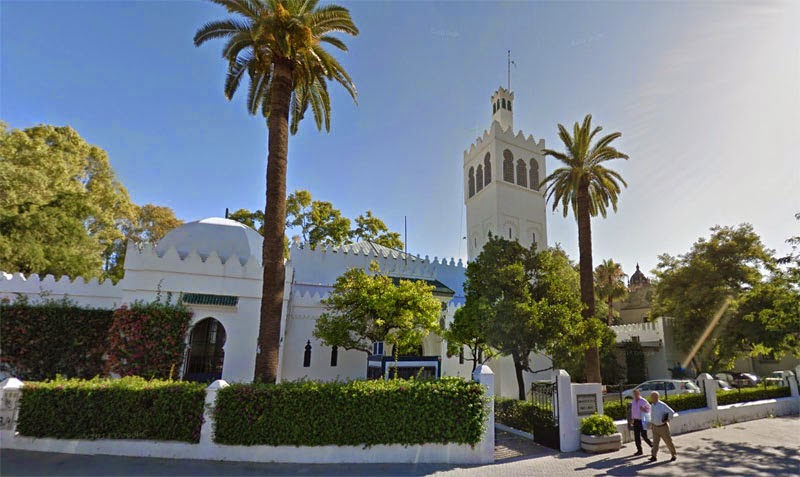
The pavilion of Morocco at the Ibero-Americana Exposicion in Sevilla 1929.

In 1929 in Spain, was held two expositions, one in Barcelona and the other in Sevilla.
These exhibitions aim to revive the national spirit, at different levels, it's the one of Sevilla which hosts the colonial and exotic pavilions in the beautiful setting of the Gardens of Delights.


This pavilion of Morocco, which lies between pavilions of Spanish Guinea and Columbia, is a fine example with a simple style, but varied, reminiscent of the mosques of Africa.
As indicated by the two ceramic plates at the entrance of the pavilion, it was made by José Gutiérrez Lescura, director of the School of Fine Arts in Tetouan, in collaboration with the painter Mario Bertuchi.
We can also read the date of 1347, which is the year 1929 on the Muslim calendar.

This Moroccan pavilion was built from 1925 to 1928 and covers an area of 680 square meters.

Vestige of the exhibition, it still exists in Sevilla, and is now the headquarters of Sevilla Parks and Gardens.


jeudi 26 février 2015

History - Morocco pavilion at New York 1964-65 World's Fair #1


Morocco Pavilion - New York 1964

The sights and sounds of North Africa are reproduced in this graceful, privately sponsored pavilion of traditional Moorish design with arches and an open patio.
One section is a bazaar, where Moroccan goods are for sale.
Elsewhere, works by Moroccan artists are on display, as well as documents and memorabilia significant to Morocco's history.
An information center offers advice on import-export trade as well as on the country's tourist attractions.
There are two restaurants and a night club.
Admission: free.

Highlights

Land of the Bazaar
Expert craftsmen and women in Moroccan dress weave carpets and make brassware and leather goods.
Visitors can see them knotting rugs - making more than 20,000 knots per square yard at the rate of a yard a week.
Moroccan foods are also on sale.

Restaurants
The two eating places offer Moroccan specialities in different surroundings and prices.
A sidewalk cafe' is in front, a serve-yourself cafeteria in back.
A supper club, Le Club de Marrakech, offers Moroccan entertainment: dancers, singers and musicians.


mardi 17 février 2015

History - Morocco at Expo'67 Montréal


 Moroccan pavilion at Expo'67

This is a country of golden fruit, of the massive Atlas mountains. A tall green and white minaret reminds the visitor that Morocco is a bridge between two worlds. The riches of its thought and art have influenced the Occident as well as the Orient. Beside the minaret is a pavilion with an eight-pointed shape like the rowel of a Moroccan horseman's spur. At the heart of the pavilion, two large dioramas are presented in the section under the cupola. One shows Tinerhir, a southern Moorish town of the rural highlands. The other features Meknes, the Versailles of Morocco, where the passionate fervour of Moorish sophistication finds fulfillment.

A nearby display has mannequins costumed as royal guards or as teachers to symbolize the city of Fez which is a model of cultural blending typically Moroccan, half of the city being Andalusian Spanish and the other, Tunisian. The mosque of Fez, the largest in North Africa, is an august  university, at least 400 years older than the Sorbonne.


In the galleries around the rotunda of the pavilion, colour photographs, more costumes and statues reflect the Moroccan past which enriched itself from the civilizations of the Mediterranean area and in return transmitted to the Christian world the cultivation of rice, buckwheat, sugar cane, ginger, cotton, silk, bananas, cherries, as well as oranges, lemons, and grapefruit, the mythological golden fruit.

In adjacent display cases, the visitor can see such treasured relics of the past as a neolithic vase, a Phoenician sphinx, a Punic lamp, a Bacchus, and a Berber bust from the Roman era. There are other glories - ancient Berber coins and jewels lent by the Rabat Museum; daggers, ceramics, caskets and pieces of forged iron from Meknes; embroidery from North Morocco; twelfth century bronze facings; a fourteenth century frieze.

At the exhibit of ancient manuscripts, the visitor may be reminded that early achievements in  medicine, geometry and astronomy passed through this land on the way to Europe. Thus near a priceless Koran of the twelfth century, there is an astrolabe from the fourteenth century, discovered at Rabat. The instrument is both a scientific tool and a work of art, a typical example of the refinement of the era.

In the display showing Casablanca, one of the largest ports in Africa, the modern buildings harmonize we" with the traditional style of architecture. Alongside, models and photographic montages present the new city of Agadir, rebuilt over the ruins left by the appalling earthquake which destroyed the old town some years ago. Other -exhibits show the specucular mountains, verdant valleys, coasts and beaches whose beauty attracts tourists in increasing numbers. Recent progress in the country is demonstrated by exhibits telling of school attendance, improved public hygiene, industrialization and improvement of agriculture.


At EI Mansour, the Moroccan restaurant elsewhere at Expo, the scent of sandalwood and rose-water is in the air, and soft, voluptuous divans can overcome the resistance of the most stolid westerner. He soon finds himself calling for a mechoui or some other dish which captures the refined essence of the country's culture. Chicken served with prunes is a dish fit for the angels. And during the meal, the renowned singer-dancer Lalla Hajja Hamdouia and her orchestra entertain, drawing appreciative cries of Ya Allah!


The pleasing proof that modern adaptations in the country retain typically Moroccan characteristics was given at the Hospitality Pavilion when a fashion show was presented by Mrs. Ahmed Hamoud, wife of the Counsellor to the Moroccan Embassy, Ottawa. Moroccan dressmakers produce exquisite creations by interpreting modern styles in the incredible variety of fabrics and colours provided by the ancient weaving traditions of the country's provinces.

On Morocco's national day, August 9, the Minister of Information, Mr. Ahmed Snoussi, represented his country at the Place des Nations ceremonies. He said in his speech that Morocco participated in the World Exhibition because of a desire to respond to the aim expressed by the Canadian hosts, "to transcend by mutual knowledge the differences which might exist between peoples, and to emphasize only that which would encourage nations to live together in fruitful co-operation".

The Place des Nations audience was entertained by the artists of the Moroccan Folkloric Ballet company and a parade at models in traditional costumes. Also for the national celebration, the country sent ten desert horsemen who gave a splendid performance at the playing field in lie Sainte-Hélène Park.

In the World Festival, Morocco's contribution was three performances by the same 90-member ballet company at the Théâtre Port-Royal (during the week coinciding with the national day).


mardi 10 février 2015

History - Pavilion of Morocco at Expo 2010 Shanghai


 The pavilion, which absorbs the nutrients of Moroccan culture, reflects the wisdom and innovative spirit.

The 3-storey pavilion present the heritage of Moroccan traditional civilization and the art of contemporary urban life, reflect different aspects of urban life and expectations of citizens, reflect Morocco's reflection on history, culture, environment and urban development, and embody the theme of the Expo "Better City, Better Life".


Morocco is the only African country with its own pavilion.

Building materials give us a feeling of ease. Moreover, advanced sound techniques, sound insulation, thermal insulation and environmental protection, are a piece of art for interior and exterior design of the pavilion.