Affichage des articles dont le libellé est HUNGARY. Afficher tous les articles

mercredi 29 avril 2015

Hungary pavilion... by Eletkert

Few days before the opening... the hungarian pavilion almost finished...
...the lats pics...


 Pic courtesy Életkert Pavilon


mardi 3 mars 2015

The 10 most beautiful pavilions... by GraziaCasa.it

http://casa.grazia.it/expo-2015/expo2015-milano-padiglioni-piu-belli

I dieci padiglioni più belli di Expo 2015

and the first pavilions of these awarded pavilions is...
the Pavillon Monaco !!!

1 - Pavillon Monaco
http://expo2015-milano.blogspot.fr/search/label/Monaco

2 - Russia pavilion
http://expo2015-milano.blogspot.fr/search/label/Russia

3 - Pavillon France
http://expo2015-milano.blogspot.fr/search/label/France

4 - Switzerland pavilion
http://expo2015-milano.blogspot.fr/search/label/Swiss

5 - China pavilion
http://expo2015-milano.blogspot.fr/search/label/China

6 - Hungary pavilion
http://expo2015-milano.blogspot.fr/search/label/HUNGARY

7 - Vanke pavilion (corporate)
expo2015-milano.blogspot.fr/search/label/Vanke

8 - Czech Republic pavilion
http://expo2015-milano.blogspot.fr/search/label/Czech

9 - UK Pavilion
http://expo2015-milano.blogspot.fr/search/label/UK

10 - UAE pavilion
http://expo2015-milano.blogspot.fr/search/label/UAE

mardi 30 septembre 2014

The construction of the Hungarian “Garden of Life” Pavilion commences !

The construction of the “Garden of Life” Pavilion commences – the contract of the excavation and foundation works for the Hungarian pavilion of Expo Milano 2015 has been signed.

On 17 September 2014 in Milan, Hungarian Commissioner for the Expo Géza Szőcs, along with Zoltán Fórizs, Managing Director of Carpathia Ltd, the company in charge of implementation of the pavilion, as well as Cristian Vitali, CEO of the winning Vitali S.p.A signed the excavation and foundation works contract. The Hungarian pavilion, christened the Garden of Life pavilion will be an intelligent and interactive building, welcoming visitors with a host of Hungarian innovations.


At 11:00 on 11 August 2014, Carpathia National Creative Economic Development and Innovation Ltd. launched a public tender for the excavation and foundation works of the Expo Milano 2015 Hungarian Pavilion in accordance with §122A of the Public Tenders Act.

The winner of the tender, the Italian owned Vitali Group is Italy’s leading construction company, with decades of experience in other European countries as well.

The first step of the construction will commence on EXPO Plot S28 after the signing of the contract,
with a predicted completion of early October 2014.

The protection of the natural surroundings already receives special attention during the foundation
works, with the excavated earth being deposited in Milan until autumn 2015, when, during the
compulsory restoration of the plot, the same earth will be placed back once the pavilion is transported to Hungary.


Hungary places special emphasis on the environmentally friendly construction of the pavilion: most of the materials used in its construction will be reused in Szombathely, and any waste generated during the 2015 deconstruction will be recycled in the construction industry.


samedi 20 septembre 2014

More details about the pavilion of Hungary ->

ALAKOR - The Hungarian pavilion 

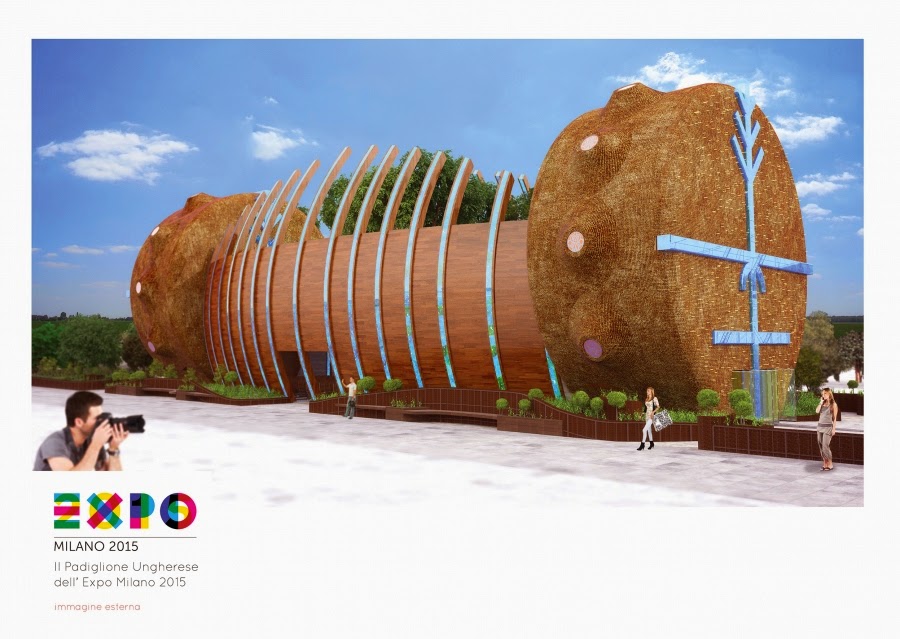
The thorough tender procedure resulted in powerful and exciting building plans, which fit in perfectly with the theme of the EXPO. Both the appearance of and use of materials in the Pavilion embody one of the main trends in Hungarian architecture, which borrows from the carpentry and joinery of folk traditions (stables, barns, silos) as interpreted by the organic architecture of Károly Kós and Imre Makovecz. It reflects on living nature, using both forms and materials that seek harmony through environmentally conscious architecture.

The shamanic drums at both ends of the building refer to the ancient roots and the mystical bond between humans and nature, while the central barrel is a symbol of abundance, easily associated with Noah's Ark, the saviour of life. Atop it all sits the roof garden, showcasing the kaleidoscope of life.
The ribs or staves stretching up to the sky past the garden could be part of a monumental skeleton, but at the same time show openness towards the sun, protecting the core like giant petals and leaves on a plant.


Functional spaces in the building 
The first shamanic drum encompasses three levels of exhibition displays. Visitors can access the lowerlevel from the outside, and then move on into the central space of the event room. The higher levels of the drum can be accessed from the direction of the central area. The central space on the ground floor is a multifunctional event area, with services areas behind it (HVAC, bathrooms). The elevator and the stairs can also be found here. The second floor has a walkway around the walls, where pictures can be displayed.
The stairs lead up to the roof. The central axis of the main facade houses a Tree of Life motif made of clear tubing. A closed system circulates a liquid symbolising the Hungarian sweet-, mineral- and thermal water treasures, flowing around the first drum and arriving on the level of the balcony. The third section of the building is the other shamanic drum, which houses an exhibition display on the ground floor, a kitchen for warming food on the second floor, and further exhibition space on the top
floor.
The HVAC systems for the building along with the storage spaces are at the end of the plot, in a structure hidden under a glasshouse, partially sunk into the ground. The buffer tank for the water pipes running through the balcony and facade of the building are placed under the rear garden area.
One of the most important aspects of planning was ENVIRONMENTAL WARENESS.
In order to reduce energy requirements to a minimum, the building insulation is up to passive house specifications, the glass windows are triple glazed, and have added sun protection in areas where the sun will shine upon them. The internal spaces of the building can be ventilated naturally. This makes natural cooling possible when outside temperatures are suitable, as well as allowing naturally heat absorbing elements to cool off after closing hours. The green areas of the roof garden and the mist curtain regulate the microclimate and lower cooling requirements.

Applied building materials are mainly natural, sustainable materials (wood, laminated wood, cellulose), with small ecological footprints. Also energy and time saving construction methods are used. The drip-irrigated garden, the low-water consumption mist generators, the water saving taps all serve to conserve water. The cistern also plays a part in water conservation. Grey water from tap basins is rerouted as water for flushing toilets. The building produces no harmful emissions to either air or ground, neither during construction nor operation. Environmental responsibility is not only present in the buildings operation, but is a key principle during its construction and dismantling as
well, minimizing air and ground pollution, as well as waste.
Last but not least, the entire building (save for the foundation) is reusable. As per requirements of the tender, the Pavilion is made up of pre-manufactured, easily transportable elements that can be dis- and reassembled. This means that once the Expo is over, the Hungarian Pavilion will not become waste, but will be rebuilt in Szombathely at the Cavalry Barracks as a research centre. Not only does this present an environmentally sound solution, but also saves the budget a significant amount, as the money spent on the Expo will not be for a temporary building, but one of long-lasting use and value.
In accordance with the themes of the Expo, the presentation of Hungarian values was part of the planning process from the onset. Water, as a network of flows is present throughout the entire building, referring in different forms to the Hungarian sweet, thermal and mineral water treasures. The water flows through the Tree of Life symbol on the facade of the shamanic drums, as if through a spring, and flows as a river through the garden and through the staves, with an airflow of rising bubbles representing mineral water. Another interesting display presents the changes in water at 60 hertz. At this frequency, water displays a unique serpent-like movement, and it also creates the illusion of flowing backwards. The Pavilion also has an area edicated to presenting Hungarian mineral water.

Hungary's thermal and medicinal waters, as well as its bath culture will be epresented by printed and multimedia materials, documentaries and PR videos.

The open-air garden will house the garden of elements on one end, with the egetable, spice and
herbal garden displayed on the other. The main axis of the garden will be a rubble stone riverbed, with the water flowing through it into a well. These areas are meant to show and popularize the advantages of mosaic agriculture, garden agriculture and organic food. The growing of GMO-free and ancient native species will have added emphasis.

According to plan, during the entire timespan of the Expo, visitors will have a chance to get to know 33 different fruits, 33 different vegetables and 33 different herbs, including the Batul apple, which was already planted symbolically at the laying of the foundation stone.
The goal is for visitors to the garden to find themselves in a place infused by LIFE. Surrounded by the four elements. Where fire, water, air and earth meet, the fifth element (quinta essentia), the source of life is born, represented in Hungarian tradition as in many, by the Tree of Life. The tree is the axis mundi, the pillar of the world, bridge between heaven and earth. The plant world, which is able to transmute the mineral world to living by the forces of the universe. Experiencing the elements was a central focus in designing the garden. Water flows through the garden and through the entire building.
Air is shown through the water and through displays, while the fire blazes in the furnace, and shines from the sun onto everyday items that harness it. Earth shows itself through fertility.

The garden symbolises the fertility of the Hungarian landscape, showcasing the fruits of caring and proper labour and cultivation to visitors. The vegetable garden is not separated from the flowerbeds, as the gardens of Hungarian peoples of the country were always organic and eco-gardens in a sense.


The workings of the garden are also very interactive, inviting visitors to participate in the life of the garden. They can take a walk, rest or even have a picnic. They can try their hand at gardening, watering, harvesting, composting, and experience first hand the kingdom and elements of Nature. We can teach them how to preserve the bounty of the garden without preservative chemicals, how to brew infusions for health and healing, and how to mix creams and scents. The furnace is the ideal place to learn the art of making a fire, kneading dough and baking bread, as well as drying, making jam and all the pantry tricks of old.

The roof garden is suitable for open-air events and picnicking. The sidewalls of the building reach up over the garden like the staves of a barrel. The central axis of the building is a flowing river. Stepping out of the drums unto the roof leads us to the centre of the garden, where the garden of scents grows.
All around, as the arching staves permit, small trees are planted. In this protected enclave, the trickling of the water, the colours and scents of the trees and flowers transport visitors back to the Garden of Eden. This is the quietest part of the garden. Here and in the green areas surrounding the pavilion, visitors can rest on transparent concrete benches.
Innovations

The plans of the Hungarian Pavilion contain many more innovative solutions and architectural novelties, like energy-generating stairs and floors, sound-to-electricity converter generators for the internal spaces, etc. The goal of these is to point out all the “waste” energy in our environments that can be converted to electricity. Inside the building there is a large meter display that shows the energy generated on the given day, week, month and the entire Expo.

mercredi 25 juin 2014

New Website for Hungary pavilion...

Dedicated to the pavilion !
Only in Italian an Magyar... for the moment.


http://www.expohungary.com/it

lundi 23 juin 2014

Hungary pavilion... in New York World's Fair 1939 !


Reflecting the Culture and achievements of the Magyars, the Exhibit includes displays of native arts and crafts developed during a thousand years of national existence. Here are shown peasant pottery and carving, Matyo embroidery and Halas lace, textiles, rugs, and decorated glassware.

The products of the famed Herend and Zsolnay establishments, as well as other porcelains of Hungarian origin, are represented. Export products are displayed.

A travel section reveals the attractions of Budapest and the great fertile plain of Hortobagy. Typical Hungarian food and drinks are served in the restaurant which is a part of Exhibit.

vendredi 6 juin 2014

EXPO 2015 Magyarorszag - HUNGARY pavilion Website


Concept of the Hungarian pavilion

The guiding philosophy for Hungarian participation is the interaction between healthy food and a healthy lifestyle, the guarantee of food security, together with the conservation of genetic diversity for future generations.
Hungary would like to participate at Expo Milano 2015 in the following three integrated topics.

Healthy traditions

The aim is to give priority to healthy and high-quality Hungarian food, and to the development of family farms and garden farming; the presentation of husbandry and horticulture with focus on qualitative and mosaic agriculture – taking the environment and land management issues into consideration – instead of monoculture mass production. The main objectives are the conscious preservation of the land, sustainable farming using natural resources, protection of potable water sources and soil, protection of wildlife and the environment, and to provide the population with quality food and a safe food supply.


Hungary, the country of water

Hungary is widely considered an empire of pure drinking water and thermal baths. Our goal is the familiarisation of Hungary’s thermal waters, mineral waters and natural waters, their use in healthcare therapies and for the prevention of disease, as well as their use in developing a healthy lifestyle. Hungary is famous for its different types of mineral waters, and for its thermal waters used for medical treatments.
In the autumn of 2013, Budapest is going to host the World Conference of Water. We would like to take advantage of this opportunity, and are planning to advance the main themes of this event, namely water protection concerns, the question of water scarcity in developing countries, and possible solutions for these problems.


Heritage for the future

Agricultural research, the conservation and transmission of the biological heritage by scientific methods, and innovative technologies are the first concerns for Hungary, specifically the preservation of indigenous plant and animal species (“Hungaricums”) in gene banks, as well as its related sciences and developments.

Nevertheless, the production of organic, not genetically modified (GM-free) vegetables, crops and plants is also very important or preserving the health of future generations. Hungary is among the continuously shrinking number of countries, where the production of GM crops and plants are not allowed. Hungary is a committed promoter of the production of GM-free food products.

Hungary is going to build a restaurant area for its “Hungaricum” (originally Hungarian) food products in the Pavilion and green area of the lot. Hungary would like to not only to show off its cuisine, but also provide opportunities for visitors to taste dishes. There are also going to be workshops, where recipes and preparation techniques are going to be taught. Guests are going to have the opportunity to judge the quality of our mineral waters and wines for themselves by tasting them.

During the Expo, visitors are going to have the opportunity to see exhibitions and attend fairs in the above-mentioned topics, but the pavilion is also going to be full art events and scientific programs representing Hungary, as well as programs organised on the occasions of our national holidays and feast days.

jeudi 22 mai 2014

Hungary’s Pavilion Draws Life From the Purest Source


Today saw the presentation of the Pavilion of Hungary for Expo Milano 2015: the design, selected through a public competition, reflects the theme of the Universal Exposition "Feeding the Planet, Energy for Life” and was created by the designers Attila Ertsey, Ágnes Herczeg and Sándor Sárkány. The event was attended by Géza Szőcs, Commissioner for the Hungarian Government, in the presence of Diana Bracco, Commissioner General of Section for the Italian Pavilion; István Manno, Consul General of Hungary; Giuseppe Frattini, designer of the pavilion and Zoltán Fórizs, CEO of Carpathia S.r.l.


Starting from the theme of its participation "From the purest source," Hungary will demonstrate the importance of nutritious food, a healthy lifestyle and the need to ensure food security and biodiversity for future generations. During the presentation a partnership with the Italian Pavilion was announced, which will be launched during the Universal Exposition.

The Pavilion will be on three floors and will occupy a plot of 1,910 square meters. The shapes and materials represent the main lines of Hungarian architecture (the barn, the rural silos and stables) in line with the principles of organic architecture developed in the mid- twentieth century and based on local traditions, encompassing the laws of nature and promoting the relationship between man and the universe. The central area of the Pavilion is inspired by Noah's Ark, the symbol of salvation of living things. Its two extremities recall the shamanic drums, whose ancient roots highlight the mystical relationship with nature. They bear the ancient engraved symbol of the tree of life through which flows Hungary’s fresh, natural water with its famous thermal properties.


Most of the material used for construction is renewable (wood, laminated wood, cellulose) to highlight its eco-friendly and energy-creating content combined in parallel with energy-saving and reduced atmospheric pollution features. It will be possible to dismantle, reconstruct and re-use the entire building. The top floor of the structure will host an open-air garden whilst in in the green area outside the Pavilion will be planted 33 kinds of fruits, vegetables and medicinal herbs.

During Expo Milano 2015, the Hungarian Pavilion will organize exhibitions and events with a different focus, such as the Country’s food traditions, historic Italian-Hungarian relations and other themes of contemporary culture.


Just like Italy, Hungary has expressed its intention to use the Pavilion, once the Universal Exposition concludes, for research and education. It will, in fact, be reassembled in Szombathely, in place of the Nr. 11 Hussars' Brarracks as an integral part of the Center for Protection of Creative Heritage and Development of Values.

Following the symbolic ceremony on the Hungarian lot, on April 3, Géza Szőcs, Commissioner for the Hungarian Government, and Diana Bracco, Commissioner General of Section for the Italian Pavilion, proposed a future collaboration between the two Research Institutes in order to engage and encourage the public in a healthy and sustainable lifestyle.