Affichage des articles dont le libellé est Korea. Afficher tous les articles

lundi 2 novembre 2015

BIE prizes for Expo 2015 Milano pavilions...

24 BIE (Bureau International des Expositions) awards were presented to outstanding pavilions in eight separate groups.

Large pavilions (more than 2000 square meters)
Theme development

1st - Germany


2nd - Angola 

3rd - Kazakhstan 

Small pavilions (less than 2000 square meters)
Theme development

1st - Holy See
 
2nd - Monaco

3rd - Ireland


Large pavilions (more than 2000 square meters)
Architecture

1st - France
 
2nd - Bahrain


3rd - China 

Small pavilions (less than 2000 square meters)
Architecture

1st -United Kingdom


2nd - Chile

 
3rd - Czech Republic 

Large pavilions (more than 2000 square meters)
Interior Fittings

1st - Japan
 
2nd - South Korea


3rd - Russia 

Small pavilions (less than 2000 square meters)
Interior Fittings

1st - Austria


2nd - Iran


3rd - Estonia 

CLUSTER
Theme development

1st - Algeria

2nd - Cambodia


3rd - Mauritania


CLUSTER
Interior Fittings

1st - Montenegro


2nd - Venezuela
 
3rd - Gabon
 

mardi 4 août 2015

Pavilions of Expo 2015 Milano : Republic of KOREA

 
Go to visite the pavilion of the Republic of Korea ... Already, we must talk about its location on the Expo 2015 site... could not be happier. Located near the western entrance, just after the pavilion of Brazil, Korea pavilion is bordered on the right by a wide driveway that allows a global vision of the pavilion, very clear. This is an ideal situation to detail and appreciate the architecture that may surprise visitors ... certainly a very good choice, since reacting the visitor is often a guarantee of success.
Indeed, this all white pavilion, topped with domes and small protrusions, leaves no one indifferent, one might ask what are the architectural references that prevailed in the choice of these forms.

We must not look in that direction, but rather in a report to the theme, as it is in Korean culinary art that designers find their inspiration..

 
The pavilion of Korea, as a whole, is inspired by the simple beauty of traditional Korean pottery: the "Moon Jar", part of the country's culinary heritage. These pots have always played a key role in food preservation. This is the rounded shape - like a moon - these potteries, which inspired its name.

We will see later in the visit that is not only the architecture of the pavilion is inspired by these ancient pots, but also inside, and all the themes turn around this concept.

For this visit, we enjoyed a guided tour, which allowed us to make the most of the contents of the pavilion. A hostess of Korea pavilion waiting us, for a warm welcome, and certainly with great pride show us their national pavilion. We understand them!

 
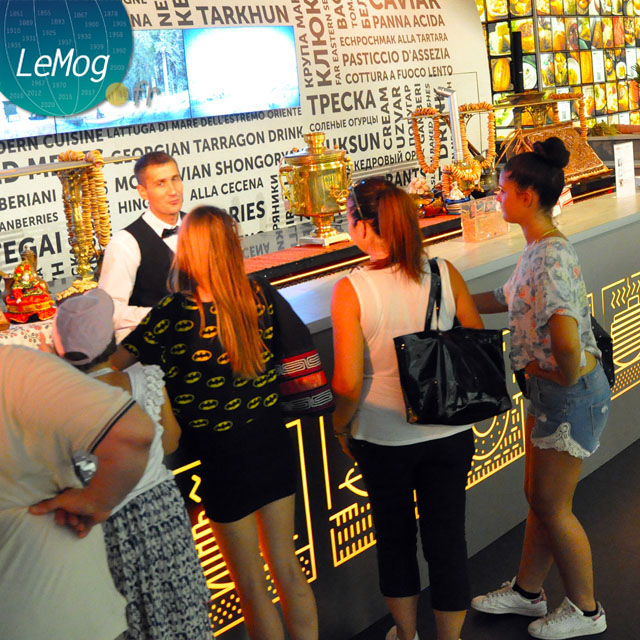
After enjoying the architecture of the pavilion, and the very welcoming entrance, we climb in the company of our hostess a grand staircase, white like the pavilion. This staircase is bordered by a wall that clearly announces the subject, with names of recipes from countries of all around the world.

The first part of Korea exhibition aims to educate visitors by allowing them to question their eating habits, and thus to make a point about the depletion of our food resources. The transition to the outside of the pavilion is smooth, retaining identical color codes ... here everything is sharp and clear, especially black and white.


In the next room, it's proposed that we understand how culture and traditions can help us in the coming years. This is the "Hansik" a culinary culture based on healthy dishes, which takes account of ingredients, colors, seasons, etc.

We are witnessing an incredible robotic symphony illustrates the many possible combinations, to ensure a balance and harmony between foods.

 
Then we learn that the basics of Korean cuisine is fermentation, a huge clay pot illustrates this principle ... explained the physiological changes that take place during the decomposition of organic elements in order to create new, able to ensure the preservation of food. One understands the interest that we have to inspire ourselves from this Korean culture, with very different eating habits, but also exciting than useful.

Overall, Korea pavilion proposes a fine blend of traditional presentations and digital presentations. It's always very nice and very well done, the beautiful reflection of modern Korea has been able to take the best of ancestral culture.

To finish our tour, we are in a room where a hundred of these pots (Onggi), are used as screens to illustrate the passing of time, the seasons that pass, illustrating this principle of natural conservation. .. Simple and effective.

 
The theme of this pavilion? "You are what you eat". Undoubtedly, the visitor will fully aware at the end of this initiatory journey "Hansik"!

Then, we descend to the ground floor of the pavilion, as to regain the year 2015, having become acquainted with the spirit of the Korean alimentation, between modernity and tradition.

Before leaving the pavilion, visitors can continue the experiment and test the Hansik restaurant, tasting the dishes he has discovered during his visit ... and also enjoy cultural products offered by the store.

 
I want to thank all the pavilion staff who assured us the best hospitality, enabling exciting experience as rewarding, giving to learn more about Korea and its culture.

This pavilion of Korea is among the best of this Expo 2015 Milano, whether in terms of architecture, development of the theme, set design, or hospitality.An absolute must !!


 Korea pavilion :
http://expo2015-milano.blogspot.fr/search/label/Korea

Links to Korea pavilion : Website - Facebook - Twitter

vendredi 19 juin 2015

History - Back to the past... Korea in World Expos...

In 2012, Korea was proud to organize for the second time an international Expo.
After Taejon in 1993, it was the turn of Yeosu to host this event in the beautiful coastal area of south Korea.

But history of Korea in Expos is much older. It begins in 1893, in Chicago.


This film in 3D computer graphics will allow to fall into the heart of this story, to discover or rediscover the pavilions that represented Korea in the Expos.

Through a selection of 12 different Expos, you will discover how Korea came to the world: Chicago 1893 - Paris 1900 - Seattle 1962 - Montreal 1967 - Osaka 1970 - Spokane 1974 - Knoxville 1982 - 1992 Seville - Taejon 1993 - Hannover 2000 - 2005 Aichi - Shanghai 2010.


http://lemog3d.blogspot.fr/

jeudi 9 avril 2015

mardi 7 avril 2015

Korea pavilion... Work in Progress... at Expo 2015 Milano

Thanks to the Korean pavilion for these last pics from the worksite ! We're very glad to see the hard work done to be ready in time...


mercredi 25 mars 2015

Korea pavilion... while waiting more pics from the Expo Cantiere !

Architecture..
The pavilion will be constructed with the architectural theme of the “Moon Jar” a traditional pottery in the shape of the full moon. During the past, ceramics in Korea were transformed from grain bowls into beautiful celadon and porcelains. These bowls represents the theme of the Milano Expo.

And a couple of new pics... from inside...


mardi 17 mars 2015

Logo of Korea Pavilion revealed !!!

Thanks to the Korean pavilion... discover together the Logo of the pavilion of Korea...
... so nice !


jeudi 12 mars 2015

History - Korea at Expo 1900 Paris

Let's talk a little history, World Expo history, but especially the history of Korea's participations in the World Expos.

French newspaper, color engraving, pavilion of Korea.

The first participation was in Chicago in 1893, but Korea doesn't have a real pavilion yet. The country products exhibited was gathered in a small booth that was inside the main palace of the Expo.

It wasn't until the second participation of Korea to a World Expo to see a real pavilion, which represents the country.

First project for Expo 1900, Delors de Gléon.

The first pavilion was the one of 1900 World Expo in Paris.
That we will find below is not the one expected. Indeed, it's french specialist of reconstruction , Mr. Delors de Gléon, who had a huge success at the Exhibition of 1889 with its reconstruction of the Street of Cairo. He had imagined a huge and magnificent palace to best represent Korea.

Pavilion of Korea, Expo 1900 - Champ de Mars.
Rapport général Administratif et Technique - Alfred Picard - 1903

Alas, Mr. Delors de Gléon died prior to the completion of this incredible palace, whose construction would be halted. And what had been achieved was destroyed.
It was finally decided, very late, it really had to build a pavilion, but this time would be much smaller and modest.

Interior of Korea pavilion - Paul Gers - En 1900 - Ed. Crété.

This pavilion, inspired by a former royal palace in Seoul, was located at the end of the Champ de Mars, behind the galleries on the side of the gallery of machines of the 1900 Expo.
We will have the opportunity to speak in an article a little longer.

His majesty Ry Hyeng.

mercredi 4 mars 2015

Work In Progress for Korean pavilion...

Yesterday, we talk about the marvellous pavilion of Korea... but at two months of the event, it's not only a project... here's the Expo worksite... with the structure of the pavilion, already made !

Keep up the good work !


mardi 3 mars 2015

Korean Pavilion at Expo 2015 Milano : Bringing you the true Korea!

When you mention the Word Expo, people immediately reminisce back to the recent 2012 Yeosu Expo, the 2010 Shanghai Expo, and a few people may even remember further back to the 1993 Expo hosted by Daejeon. The Yeosu and Daejeon expositions were not regular exhibitions, but rather “recognized exhibitions” held for specially-themed occasions in order to share their vision to an international audience. However, this year’s anticipatory event in Milan is an official expo that will be continued for over a six-month period and will welcome over 20 million visitors from all over the globe.

Mockup design for Korean Pavilion at 2015 Milano Expo: aerial view (left)


The Korean pavilion

Korea’s pavilion will be constructed with an architectural theme based on the shape of a Moon jar, a traditional pottery vessel that takes the shape of a full moon. In the past, pottery in Korea was transformed from simple ceramic grain bowls into beautiful celadons and porcelain vessels. These traditional containers represent the Republic of Korea’s theme for Expo Milano 2015.

Interestingly, the main artifacts that will be on display here are identical to the items shown at the Chicago Exposition in 1893, at which Korea was entered for the first time as an official state member. Through observing the diverse objects on display and taking advantage of the variety of experiential programs offered, visitors to the Korean Pavilion are guaranteed to be entertained and enlightened. The organizing committee is now in full swing for preparing this fun and eye-opening pavilion!

Mockup design for Korean Pavilion at 2015 Milano Expo: front view (right)
The major theme for the Korean Pavilion is set as “Hansik’s Alternative for the Future: You Are What You Eat.” At Expo Milano 2015, Korea will provide an arena for dialogue on the future of providing economically sustainable food for humanity.

If Moon jars are a projection of Korean architecture, then this exhibit’s display will show the characteristic Korean system of fermenting and preserving food using this traditional form of pottery. The large display of pottery in the exhibit rooms will let people see, taste, and touch the process of food fermentation, and situated above the more than 360 pottery pieces packed into the rooms will be screens displaying stunning media art. Visitors can discover the what, how, and how much of traditional Korean food culture, as well as ponder the future of the Earth’s food supply and how Korean food will play a big part in it.

Photo: Onggi, the major theme object of Korean pavilion (left) / Moon Jar Pottery (right)
(courtesy of the Cultural Heritage Administration of Korea)
The first floor is comprised of a Korean restaurant where visitors can experience firsthand the traditions that they’ve discovered through the exhibits. With Korea’s jang system of fermenting food set as the theme, the menu will have various representative Korean foods, including bibimbap, jongatjip (meaning “eldest son’s family”) food, sachal (meaning “temple”) food, gungjung (meaning “royal”) food. The venue also will hold various events like inviting famous Korean chefs to prepare food for Korean food parties, and the venue is even planning to take steps to globalize Korean food by spreading it throughout the city of Milan. The Cultural Souvenir Store next to the restaurant carries Korean food-related products, ornamental Korean products, as well as traditional crafts and food products made from Korean ingredients.

Floor plan of Korea Pavilion.

Media façade using onggi (Korean traditional earthenware)
Prospective plan of Rotunda designs.
 Korean restaurant located on the ground floor.
Hansik: Enticing the taste buds of everyone!

The Korean Pavilion, taking up a site area of 3,990 square meters, is expected to play a significant role in introducing diverse culinary practices and providing solutions for future alternative food sources. This is 9th largest exhibition venue among 140 other participating countries, meaning Korea will be a core member that not only shares the country’s cultural traditions, but also unveils Korean secrets for a healthier and safer gastronomic culture, one that is rooted deep in the nation.

In addition, this event will allow for the exploration of ways to further enhance their relevance in both the present and the future of human society, utilizing highly advanced science and technology in the fields of food, environment, and human physiology.


Learn more :     http://english.visitkorea.or.kr/enu/SI/SI_EN_3_6.jsp?cid=1989506